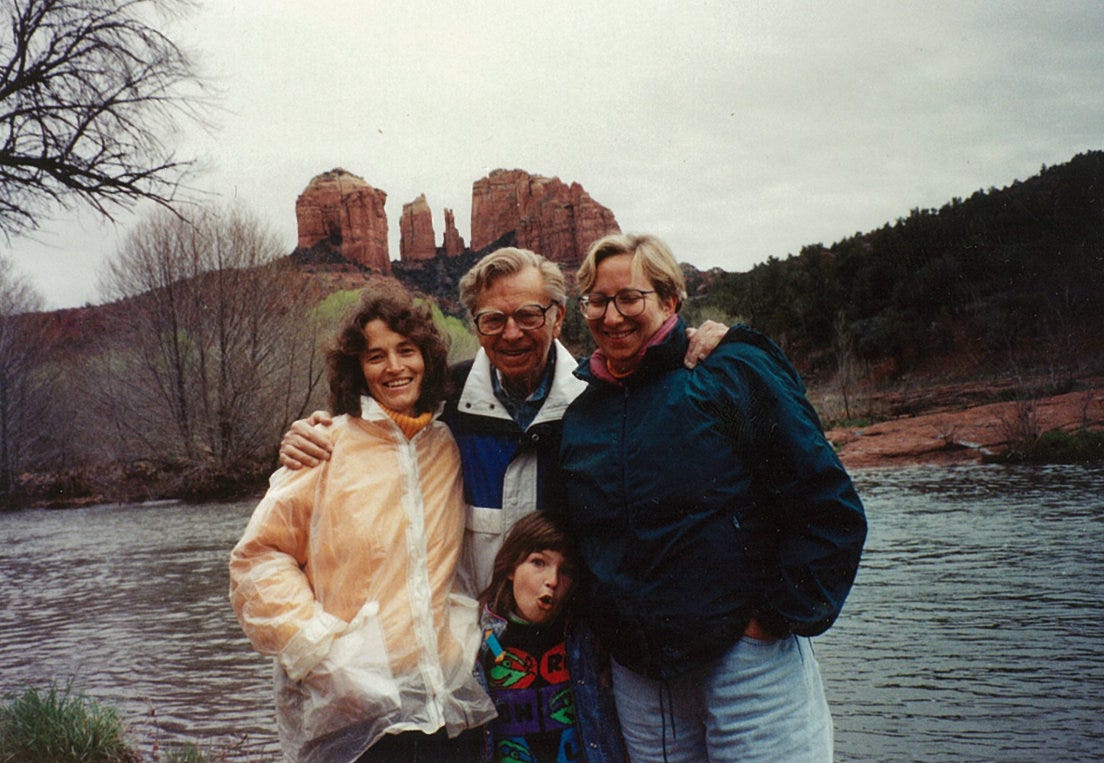
My father was a music teacher. He played a wide variety of instruments, taught children in school bands, and gave private lessons. He infused in me a deep love of music, along with other lasting gifts: a passion for hiking in nature, a wild imagination, and a family tradition of telling terrible puns that still make people roll their eyes several generations later.
Yet, I also inherited some of my father’s deeper longings. One of them was a creative dream he struggled to fulfill throughout his entire life.
My father had always wanted to become a professional musical composer. He even studied music composition at New York University, but after a year, he concluded that he simply didn’t have enough talent to make it as a composer. He chose a more humble path and became a music teacher instead.
Later in life, after retirement, he lived in an alternative housing community in San Francisco. Having earned a law degree, he supported himself through low-fee public defender work, standing up for people who were underprivileged and underserved. That fit his generous and idealistic nature perfectly.
But the dream of composing music never left him. In his later years, he decided to give it one more try, tapping into what I now recognize as the infinite fountain of love that drives all true creative expression.
The Digital Evolution of a Dream
Around that time, computers were beginning to open completely new possibilities for independent musicians. A company released a software program called Band-in-a-Box, allowing people to create full compositions with the help of digital instruments and automated accompaniment.
My father bought everything: the computer, the software, and the microphone. He gave it his absolute best effort. Yet, once again, he decided that he didn’t have the patience or the deep concentration to pursue the dream. Eventually, he offered the equipment to me. I don’t think I ever accepted it at the time. Yet, something of his artistic dream continued living quietly within me.
Over the years, I wrote many original songs and eventually recorded my own album. In a sense, I had already carried my father’s dream several steps further than he had been able to. Then recently, I felt called to take the next step and professionally record more of my newer, better original music.
I asked an AI tool which software would best support that modern recording process, and to my surprise, one of the strongest recommendations was still Band-in-a-Box—now vastly more powerful than the version my father had tried in the 1990s. So, I purchased it and began recording one of my recent songs, titled Fountain of Love.
Reconnecting with the Source
The heart of that song is simple: there is an infinite fountain of love within me and within you. When we reconnect with that source, we no longer need to grasp or desperately seek fulfillment from outside ourselves. We become fountains of giving, and everything in our lives begins to rise to a significantly higher level.
As I worked on the digital recording, I found myself thinking deeply about my father. Here I was, completing something he had longed to do but believed he could not accomplish. It felt deeply meaningful to offer that energetic fulfillment to his soul.
Perhaps this is one of the ways life unfolds across generations. We inherit unfinished dreams, and we have the power to complete them.
Our parents and ancestors give us many gifts for which we can be profoundly grateful. Yet, we may also inherit their unspoken burdens, limiting beliefs, unfinished dreams, and sometimes what I have encountered in energy healing work as family curses or karmic loops.
Healing in Both Directions
I believe it is our responsibility to release the old agreements that keep us carrying unnecessary burdens, while courageously completing the creative and spiritual paths that genuinely belong to us. When we do, we create deep healing in both directions. This concept is closely supported by psychological research into intergenerational trauma and ancestral healing, which shows that resolving emotional patterns in the present helps break cycles passed down by previous generations.
We move forward into a fuller expression of our own lives, and from the overflowing infinite fountain of love within us, we send blessings back to those who came before us.
In many Asian cultures, ancestors are deeply honored and included as living participants in daily family life. I believe there is great wisdom in that. Our personal healing does not happen in isolation; it ripples backward and forward through generations.
Perhaps one of the greatest gifts we can offer our parents is not merely passive gratitude, but the willingness to fulfill the highest dreams that remained unfinished in them—and to carry them forward with joy.
Frequently Asked Questions (FAQ)
What does the “infinite fountain of love” symbolize in ancestral healing?
The infinite fountain of love symbolizes the limitless source of creative and emotional energy residing within each person. When you access this inner source, you stop looking for external validation and gain the spiritual strength required to clear inherited family burdens and complete unfinished ancestral goals.
How can writing music help heal intergenerational trauma?
Artistic creation, such as composing music, acts as a powerful somatic and emotional conduit. By bringing expression to feelings or creative goals that a parent or ancestor had to suppress due to life circumstances, you actively release the stagnant emotional energy stored within your family’s lineage.
What is the best way to identify an inherited family burden?
Inherited burdens often manifest as repeating life patterns, irrational fears, or limiting beliefs that don’t seem to match your personal lived experiences. For example, a persistent belief that you “aren’t talented enough” to create art may be an echo of a parent’s unresolved self-doubt rather than your own reality.